
How Much Is a Sideshow Banner Worth? A Collector’s Guide to Banner Values
If you have found a hand-painted canvas rolled up in a barn, inherited a banner from a family member who worked the carnival circuit, or bought one at an estate sale, the first question is always the same: what is this thing actually worth?
The honest answer is that sideshow banner values range from a few hundred dollars to tens of thousands. The current auction record for a sideshow banner stands at $28,800, set in September 2020 at Potter & Potter Auctions in Chicago for “Cavalcade of Wonders. Freaks Past & Present,” a 20-foot entrance banner attributed to Fred G. Johnson. It had been estimated at $6,000–$9,000 and drew 24 bids.
Most banners do not reach that level, but many are worth far more than their owners realize. As co-author of Painters of the Peculiar: A Guide to Sideshow Banner Artists & Their Respective Work, and a collector who has handled, bought, sold and authenticated original banners for years, here is how I evaluate a banner’s value.
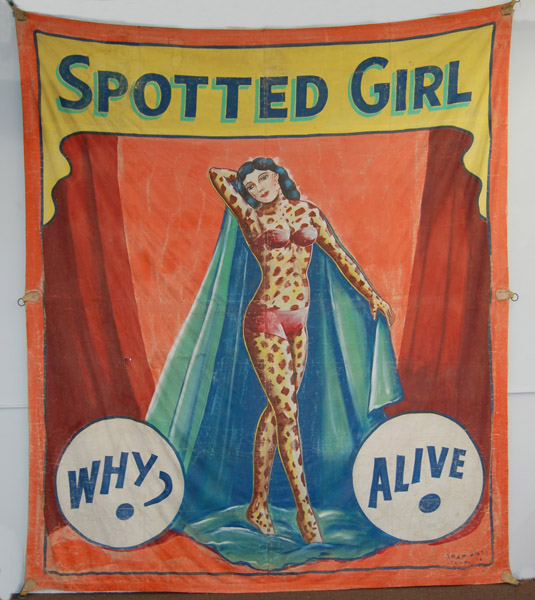
The Five Factors That Determine Sideshow Banner Value
1. The artist
The artist matters more than anything else. Banners by the two most famous painters — Fred G. Johnson (1892–1990), the “Picasso of circus art,” and David “Snap” Wyatt (1905–1984) of Tampa — consistently command the highest prices. Signed, well-preserved examples by either artist typically sell in the $1,500–$8,000 range, with exceptional or oversized pieces going much higher. A pair of Wyatt’s massive Riverview Park “Palace of Wonders” banners were each estimated at $8,000–$12,000 at Potter & Potter’s April 2022 sale.
Beyond Johnson and Wyatt, values track name recognition and rarity:
- Nieman Eisman — one of the earliest major banner painters, active in Chicago from around 1910. His banners are rare and highly collectible, and are frequently confused with early Fred Johnson work.
- Jack Sigler / Sigler & Sons of Tampa — a well-known name among collectors. “Sigler, Tampa” signed banners appear regularly at auction, typically in the mid-hundreds to low thousands depending on condition and subject.
- “Tattoo Jack” Cripe (1918–1992) — painted for Sigler & Sons Art Service beginning in 1947. His work carries strong collector interest.
- Clarence “Cad” Hill / Rosshill / Hill & Shafer — an earlier, more painterly class of banner art. Rare and increasingly sought after.
- Millard & Bulsterbaum — the early Coney Island studio. Genuine examples are scarce.
- Johnny Meah — the last of the great traditional banner painters, still living. His work hangs in the Smithsonian and the Barnum Museum.
Unsigned banners can still hold real value if they can be reliably attributed. That is exactly why attribution expertise matters: a banner correctly identified as an early Eisman is a very different asset than “anonymous circus banner.” Our guide to identifying banner artists covers how that judgment is made.
2. Condition
Banners were working advertisements. They were flown in rain and sun, folded wet, patched in the field, and discarded when the act changed. Almost none survive in mint condition, and collectors accept honest wear: small tears, patches, staining, and paint loss consistent with show use.
What kills value is overpainting. Heavy restoration that repaints original artwork essentially destroys what made the banner collectible. Sympathetic repairs that stabilize the canvas are fine; a “refreshed” banner is not. If you are considering restoration, talk to someone knowledgeable before any paint touches the canvas.
3. Subject matter
Iconic sideshow imagery drives demand. Headless girl illusions, sword swallowers, tattooed ladies, fire eaters, snake charmers, two-headed wonders, and banners tied to famous performers such as Frank Lentini the three-legged man or tattooed lady Betty Broadbent attract more bidders than generic acts. A Snap Wyatt “Headless Girl” banner estimated at $1,500–$2,000 sold for $4,000, double its high estimate, largely on the strength of its classic subject.
Entrance banners and large “cavalcade” pieces depicting a full cast of performers are especially desirable, which is why the world-record banner was an entrance piece.
4. Size and visual impact
Banners run from single-act pieces around 8 x 10 feet to entrance banners over 30 feet long. Monumental scale adds drama and value, but it also limits the buyer pool to those with the wall space. The sweet spot for many collectors is a strong single-subject banner that can actually be displayed in a home.
5. Provenance and show use
Collectors prize banners that can be tied to a specific show, park, or performer. A banner documented to Riverview Park, a named ten-in-one, or a known performer’s act carries a premium over an identical banner with no history. Grommets, leather corners, rope wear, and stitching patterns all help confirm genuine show use, and help with dating and attribution.
Realistic Price Ranges
Every banner is one of a kind, so treat these as orientation, not gospel:
- $300–$1,500 — unsigned or unattributed banners, later pieces, banners with heavy condition problems
- $1,500–$5,000 — signed Wyatt, Johnson or Sigler banners with typical show wear; strong unsigned banners with solid attribution
- $5,000–$12,000 — exceptional examples: large scale, iconic subjects, top-tier artists, documented provenance
- $12,000+ — the rare best-of-the-best: record-class entrance banners, museum-quality early works, pieces published in reference books
Publication history matters too. Banners illustrated in Freaks, Geeks and Strange Girls or documented in Painters of the Peculiar carry a verifiable pedigree that supports stronger prices.
Common Mistakes That Cost Sellers Money
- Selling on a guess. Misattribution runs in both directions — banners sold as “unknown artist” that are actually early Eisman or Johnson, and banners optimistically labeled Wyatt that are not.
- Overpainting before sale. Restoration that repaints original art can cut a banner’s value dramatically.
- Cutting a banner down. Never trim a banner to fit a frame or a wall. Original dimensions are part of the object’s history.
- Ignoring the hardware. Grommets, rings, leather corners and rope are evidence of authenticity. Do not remove them.
- Storing it wrong. Roll, do not fold. Keep it dry. Mold and new fold-cracks create damage that cannot be undone.
Get a Free Appraisal
If you have a sideshow banner and want to know what it is worth, or you are thinking of selling, I am happy to take a look. I have spent years studying and authenticating these pieces, and I co-authored the reference guide used to identify banner artists.
Send photos of your banner — full front view, any signatures or stamps, corners and hardware, and any damage. I will respond with an honest assessment of the artist, era and realistic market value. There is no charge and no obligation.
Request a free sideshow banner appraisal — or call or text 518-774-6234. You can also browse the banners we currently have for sale.
Sources: Potter & Potter Auctions sale results (September 2020, April 2022); Antiques and The Arts Weekly; The Hot Bid interview with Gabe Fajuri, Potter & Potter Auctions; LiveAuctioneers and Invaluable auction records; Painters of the Peculiar: A Guide to Sideshow Banner Artists & Their Respective Work.