
Anatomy of a Banner Line: How the Ten-in-One Sideshow Turned Canvas Into Cash
Every sideshow banner in every collection today exists for one reason: it once stood between a fairgoer and their pocket money. To really understand a banner — why it’s the size it is, why the colors scream, why the word ALIVE appears in letters two feet tall — you have to understand the machine it was part of. That machine was the ten-in-one sideshow, and the banner line was its front door.
Here’s how the whole operation worked, piece by piece, in the language the showmen themselves used.
The Ten-in-One
The classic American sideshow of the twentieth century was the “ten-in-one” — ten acts (give or take) under a single tent for a single admission price. Sword swallowers, fire eaters, human blockheads, fat folks, giants, working acts and born-different performers, one after another on a platform, all day long, as crowds cycled through. It traveled with carnivals and circuses and set up on the midway, the strip of shows, rides, and games at the heart of every fair.
The ten-in-one had smaller cousins. A “single-o” was a one-attraction show — one banner, one wonder, one dime. Grind shows ran continuously with recorded or repeated pitches “grinding” away. But the ten-in-one was the flagship, and it needed a front big enough to match: often a hundred feet or more of painted canvas.
The Banner Line
That front was the banner line — a row of hand-painted canvas banners, hung side by side on poles and ropes, one banner per act, running the full width of the show. A single-o might fly one or two banners; a full ten-in-one flew a wall of them, typically with a ticket box in the middle and a bally platform out front.
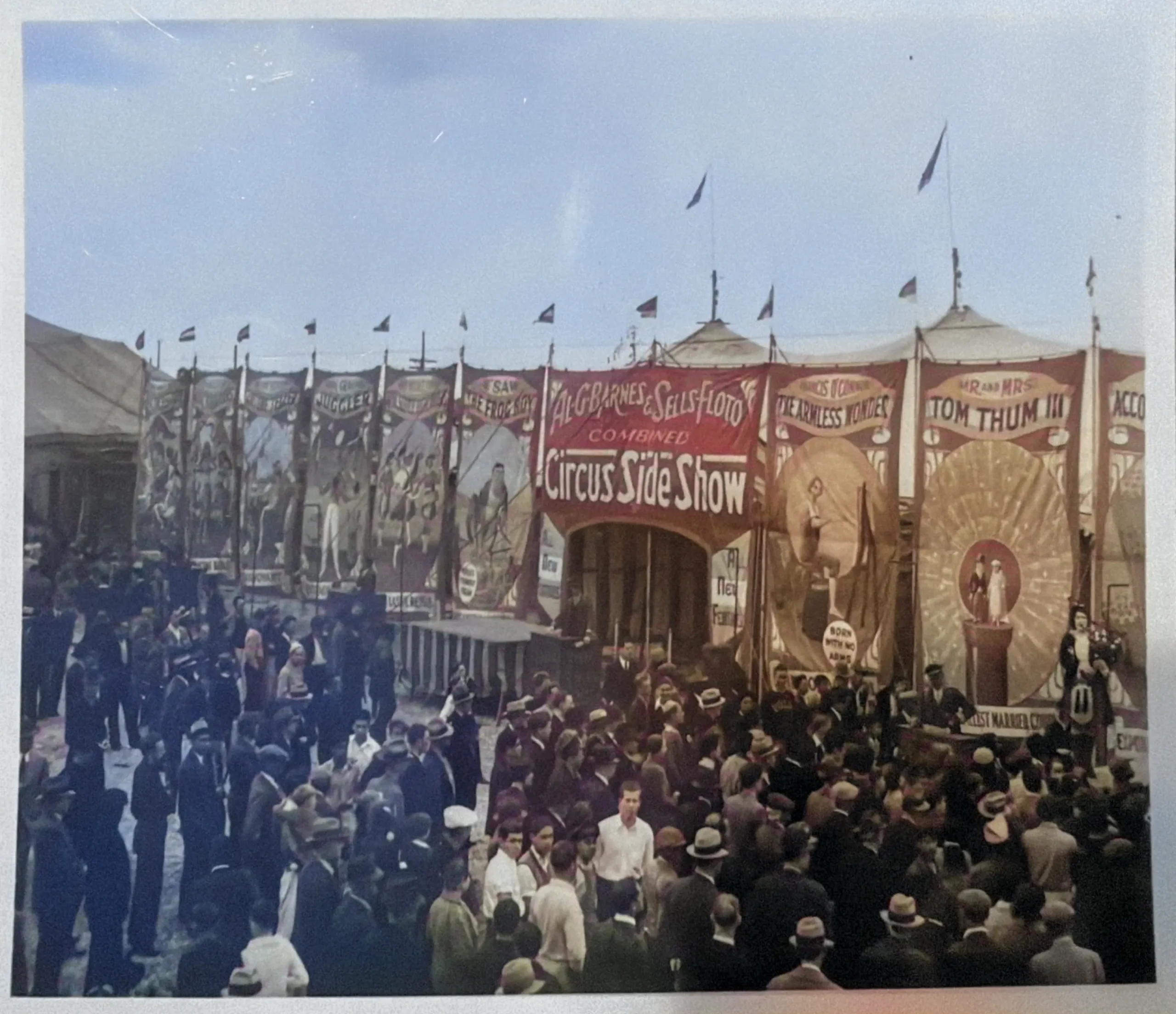
The banners came from specialist studios — United States Tent & Awning and O. Henry Tent & Awning in Chicago, Millard & Bulsterbaum at Coney Island, later the Tampa painters like Snap Wyatt and the Sigler studio. A standard banner ran about eight feet by ten feet, big enough to be read across the midway but sized to pack onto a truck and go up fast on a rope-and-pole rigging in any weather.
And here’s the part collectors love: the banners were advertising, not documentation. The girl on the canvas was always more beautiful, the giant taller, the serpent longer. Fred Johnson himself put it plainly — the secret was color, and never mind exaggerating the subject. Showmen called this “flash”: the visual sizzle that separated a customer from a quarter. Nobody sued a sideshow because the Alligator Girl inside didn’t match the twelve-foot masterpiece outside. That gap between promise and reality is baked into every banner ever painted, and it’s exactly what makes them irresistible as folk art today.
The Bally
In front of the banner line stood a small stage — the bally platform. “Bally” (or ballyhoo) is the free show outside the show: a performer or two brought out where everyone can see them, a few teaser stunts, just enough to stop foot traffic. Showmen have long claimed the word was born at the 1893 World’s Columbian Exposition in Chicago, on the Midway Plaisance itself — the story goes that it grew out of shouted exchanges at the “Streets of Cairo” pavilion. Like a lot of carnival etymology, the tale is better documented in showmen’s memories than in dictionaries, but the practice is as old as the fairground.
The crowd that gathers in front of the bally is called the “tip.” The whole art of the front end was building a tip, working it to a froth, and then “turning the tip” — converting the gawkers into ticket buyers before the excitement cooled.
The Talker (Never the “Barker”)
The man on the bally with the microphone — or before that, the megaphone, or just a leather set of lungs — was the talker. Outsiders say “barker”; nobody on a lot ever did. The outside talker built the tip and turned it. The inside talker, or lecturer, then guided the crowd from platform to platform inside the tent, giving each act its story, its medical mystery, its jungle origin, its royal pedigree.
The talker and the banner line worked as a unit. The canvas made the promise in paint; the talker made it in words; and between the two of them, the dime found its way out of the pocket. Ward Hall — the “King of the Sideshow,” who ran the World of Wonders ten-in-one for decades until his death in 2018 — was widely considered the greatest talker of the late era, and he could turn a tip with nothing but rhythm and nerve.
The Blowoff
Inside, after the last scheduled act, came the blowoff (or “blow”): one final attraction, behind one more curtain, for one more small fee. Maybe it was the two-headed baby “pickled punk” in a jar, maybe the “What Is It?” Whatever it was, it was where a slow day became a profitable one. The blowoff is also why some of the strangest and most lurid banners exist — a blowoff attraction needed its own special flash inside the tent.
Why This Matters When You Look at a Banner
Once you understand the front end, features of banner art that seem odd suddenly make sense:
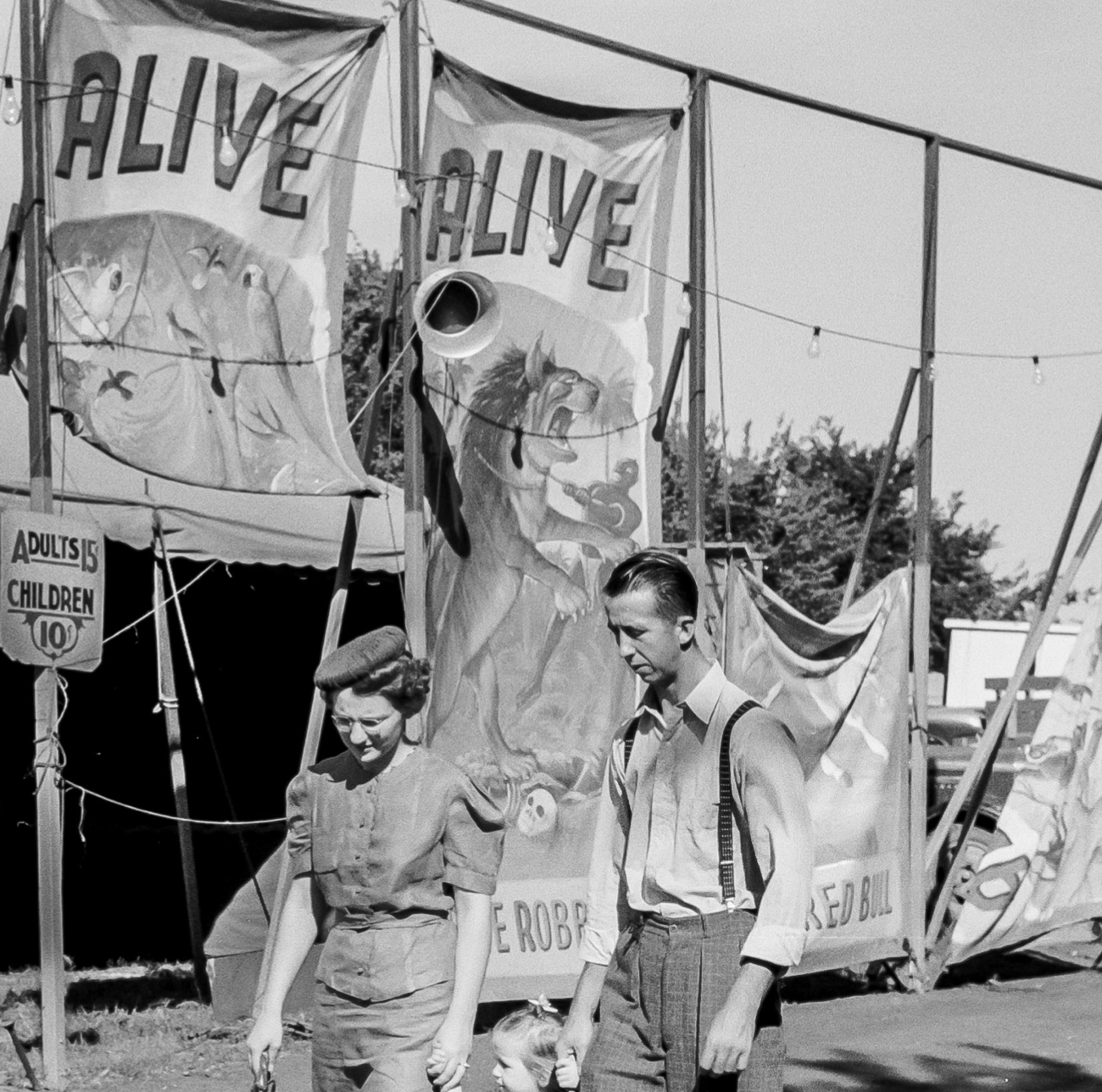
The word ALIVE. After decades of gaffed mummies, pickled specimens, and painted humbug, “ALIVE” was the strongest single word in the sideshow vocabulary. It meant: this one is real, breathing, and inside right now.
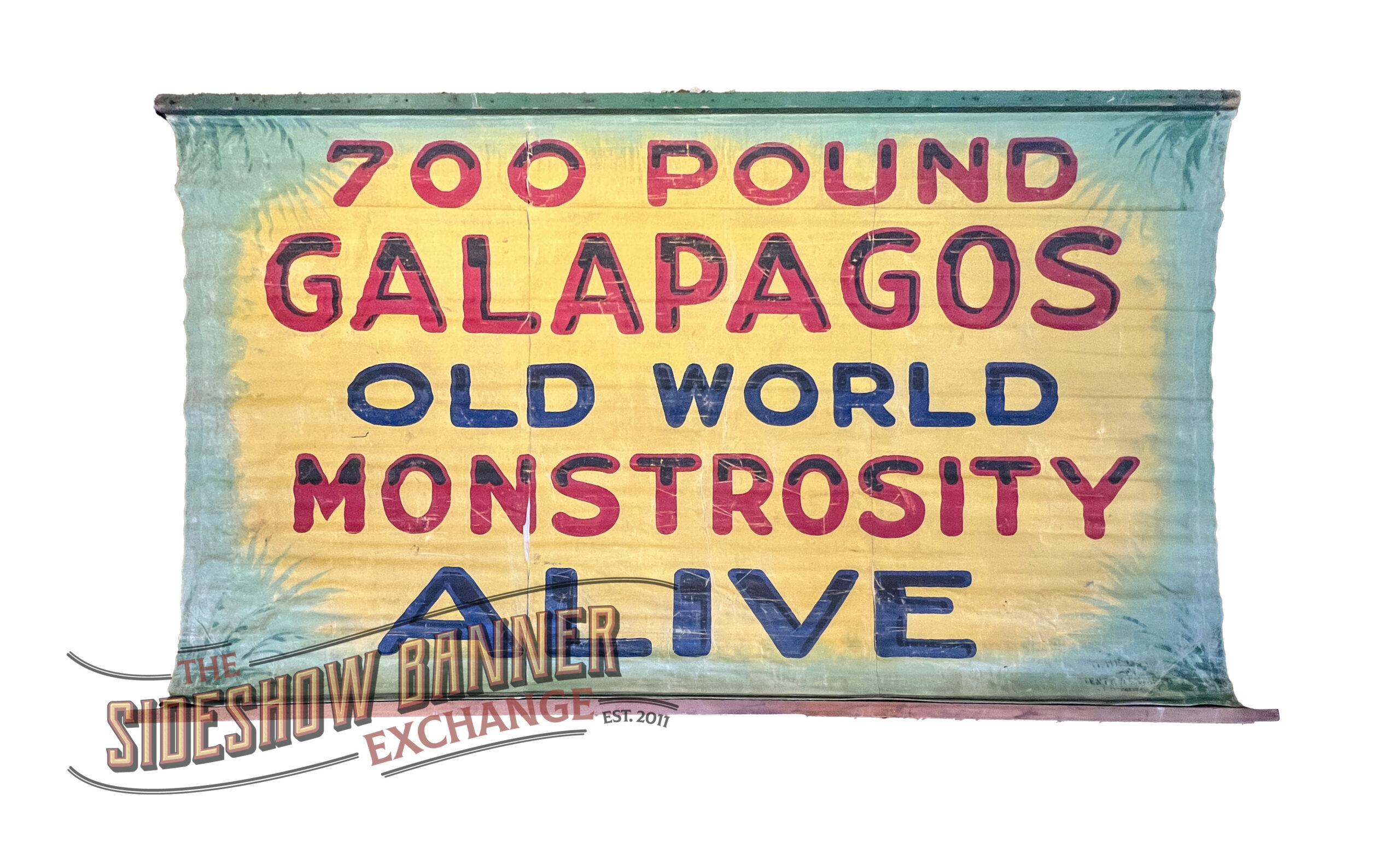
The size and proportions. Banners are roughly the shape they are because banner lines were modular — panels had to hang uniformly off the same rigging, truck after truck, lot after lot.
The weathering. A banner might fly six days a week, all season, in sun, rain, and prairie wind, then get folded wet, packed on a truck, and mended with twine by a roughie in the morning. When you see stains, rope burns, re-stitched hems, and patched corners on an original banner, you’re looking at its employment history.
The subjects. Banners followed the economics of the show. When public taste (and local laws) turned against exhibiting human oddities in the 1960s and 70s, the shows shifted toward illusion acts, animal oddities, and grind-show material — and the banners shifted with them. You can often date a banner by what it’s selling as much as by who painted it, something we touched on in our guide to valuing banners.
The End of the Line
Television, changing sensibilities, and state laws against exhibiting “human curiosities” strangled the classic ten-in-one over the 1960s and 70s. By the time Ward Hall’s World of Wonders was making headlines as “the last ten-in-one” in the 2000s, the banner lines that once stretched down every midway in America had mostly been cut up, burned, painted over, or left to rot. The survivors ended up in the hands of collectors — which is the only reason we get to study them today.
If one of those survivors ended up in your hands — from a relative who ran with a show, a barn find, an auction lot — we’d love to see it. The Sideshow Banner Exchange offers free appraisals on any sideshow banner: call 518-774-6234 or email michaelpapa121@gmail.com. And for the deepest dive available on the painters behind the banner lines, grab Painters of the Peculiar by Michael Papa and Johnny Meah at paintersofthepeculiar.com.